Automating mundane, repetitive calls with AI
Companies always strive to automate processes, particularly those requiring human inputs that tend to be repetitive, administrative in nature and fairly mundane. A popular way of addressing this issue in human-system interfaces was robotic process automation (RPA), but until recently, human-human interactions were harder to automate.
Ben Fistein
Co-Founder
Featured Image
Automating mundane, repetitive calls with AI
Companies always strive to automate processes, particularly those requiring human inputs that tend to be repetitive, administrative in nature and fairly mundane. A popular way of addressing this issue in human-system interfaces was robotic process automation (RPA), but until recently, human-human interactions were harder to automate.
Why? Because the tools available to communicate with people were rule-based and rigid. With LLMs, however, the game changed entirely. You’re probably already used to asking ChatGPT for information or advice and you must have noticed that it doesn’t matter how informally you ask or even how many typos you make, ChatGPT finds a way to answer while sounding highly natural.
The next level of AI-human interaction means you can use voice instead of text. And this is what we do at Semantee — so let’s take a look at the state of this technology and what it can achieve.
Automating and scaling CATI
The advantages of this technology are clear:
- Cost effectiveness: the bot takes no breaks, works 24/7 and never gets tired
- Scaling: we can deploy multiple instances of voicebots in parallel, enabling the company to reach 10–20x the sample size in a short timeframe
- Consistency: the bot asks the same exact question in the same manner every time, adding to the validity of the survey
- Emotional stability: regardless of how many failed calls or how mean the respondents are, the voicebot shows no emotion
Better results than human operators
One of the major concerns we face is whether the voicebot will actually be successful in its interactions with humans. We’re so used to old school IVR systems that reply in annoying patterns, don’t understand us when we stray from its pre-programmed scenarios and generally don’t offer much help. But to everyone’s surprise, the AI voice agent seems to have better results than human operators:
Comparison of human vs. AI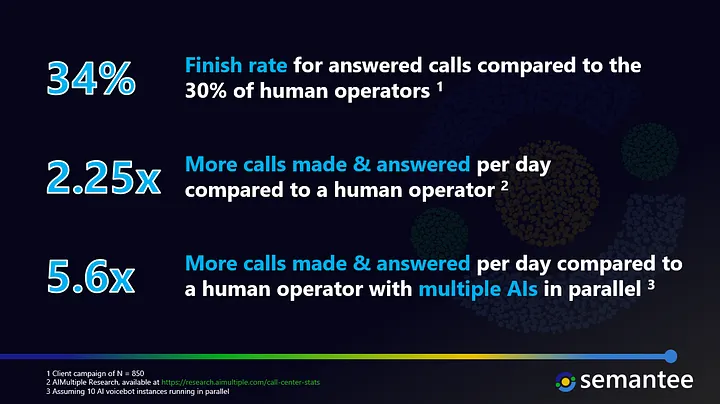
Where humans typically finish 30% of surveys when respondents actually answer the phone, our AI in fact had a 34% finish rate. Not to mention that it was able to make more than two times the amount of calls in the same timespan.
Another major question is whether people will actually accept speaking to a voicebot. Again, our data shows that our AI agent was surprisingly pleasant for people to talk to and a majority found the calls rather pleasant:
Survey results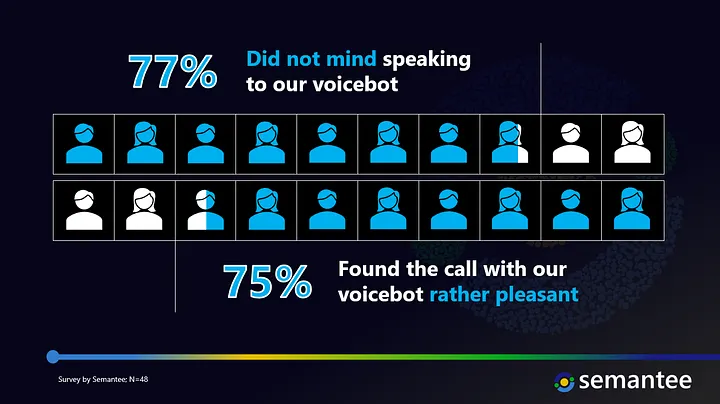
Using AI for individual projects
As the results above suggest, we also asked the employees of research agencies whether they could see their company using our AI for CATI and the results are clear:
Research usage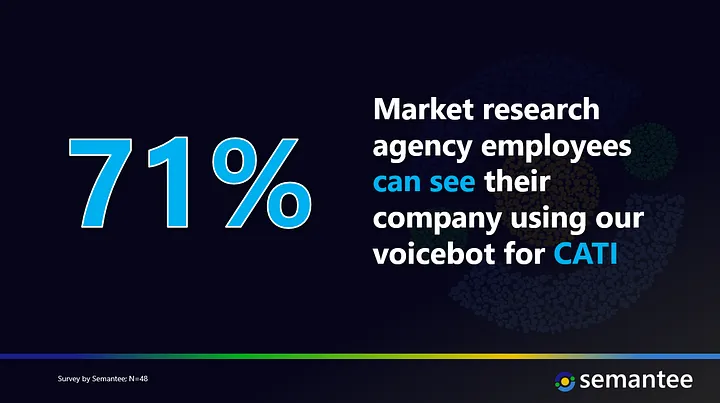
Got an individual project or use case you could see yourself automating with AI? Get in touch with us!